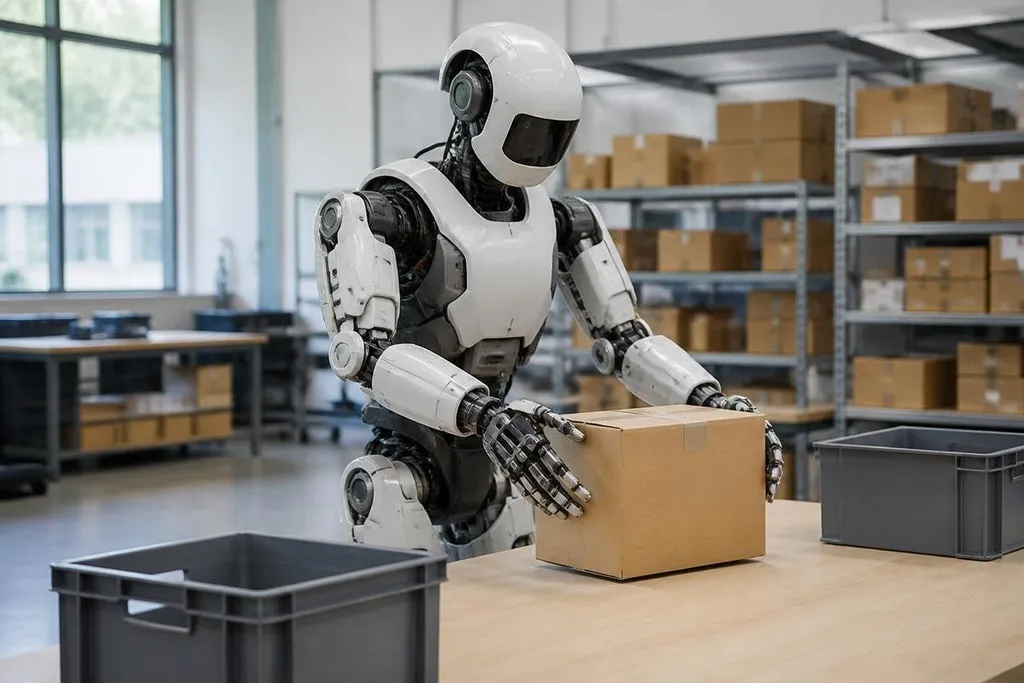
A humanoid robot can have motors, cameras, and working hands, yet still fail when a box sits a few centimetres out of place. AI changes the control problem by helping the robot connect what it sees with the task you gave it.
The result is a machine that can handle more variation than a fixed script, but the hard parts remain balance, safety, and reliable work over a full shift.
Quick read
- AI links camera input, spoken instructions, and motor commands.
- Learned control can handle small changes in an object’s position.
- Safety checks and human control still matter when the robot leaves a lab.
From fixed moves to learned actions
Traditional robot programs tell each joint where to move and when to stop. That works well beside a fixture that never changes, but a humanoid faces loose cables, uneven floors, moving people, and objects it has not seen in the same position before.
AI can split this work into several parts. A vision system reads camera images, a language model turns a spoken or written task into steps, and a control system sends commands to the motors. A vision-language-action model joins those links so the robot can connect words, objects, and movement.
That link matters when the task is broad. “Pick up the red tool” requires the robot to find the tool, work out which hand can reach it, close the gripper with enough force, and carry it without dropping it. The robot still needs separate rules for speed, balance, and safe contact.
Why humanoid bodies need better control
A wheeled robot can keep its base stable on a flat floor. A humanoid shifts its weight while walking, reaches beyond its feet, and may need to recover after a small push. Each leg has to place a foot while the other leg carries the body.
AI can learn movement patterns from recorded motion, simulation, or human demonstrations. The control system can then adjust a step when the floor, load, or body position differs from the training example. That does not remove the need for joint encoders, cameras, force sensors, or limits on motor torque.
The useful change is speed of adjustment. A fixed script may stop when a part moves 5 cm. A learned policy can estimate the new position and try a different reach, provided its training covered enough similar cases.
Training before the factory floor
Most humanoid robots need practice before people put them near tools, shelves, or production lines. Simulation lets engineers run many trials without wearing out motors or risking a collision. The gap between simulation and a real robot still causes trouble because cameras, cables, floor surfaces, and motor response differ from the model.
Teleoperation helps fill that gap. A person controls the robot or guides its hands, and the system records the camera view, joint positions, and action taken. Those records can become training data for later autonomous runs.
A box-picking model trained on identical cartons may fail when a soft bag bends under its gripper or a shiny part confuses its camera. That matters because a humanoid trained on tidy examples can stop when a handle sits behind another object, even though the task looks easy to a person. Reports from Robot24.com can show whether the robot faced mixed objects and changing light before it ran on its own. The next section looks at what AI still can't fix.
What AI still doesn't solve
AI can select an action, but it doesn't make the hardware stronger. A humanoid still needs enough battery power, motor torque, grip force, and cooling to finish the task. It also needs a safe response when a person enters its path or a load starts to fall.
Reliability is the test that short videos avoid. A robot may complete one lift after several attempts, yet a factory needs repeatable work across hours, shifts, and changing parts. Public demos rarely show failed trials, recovery time, maintenance, or the cost of supervision.
I’d judge a humanoid by its repeatable task record, not by how smoothly one clip runs.
A practical buying check
If you're assessing an AI-based humanoid for a real site, check these points before a trial:
- Task definition: name the object, weight, reach, speed, and allowed errors.
- Evidence: ask for repeat counts, failed attempts, human interventions, and the test setting.
- Safety: check force limits, emergency stops, obstacle detection, and what happens after a sensor fault.
- Work cycle: measure battery runtime, charging time, walking time, and recovery after a stop.
- Data needs: ask who supplies training data and whether your parts can be added safely.
- Cost: include operators, repairs, software fees, spare batteries, and site changes.
These checks separate a useful control system from a polished demonstration. They also show where AI can help and where better motors, sensors, or task design are still required.
Humanoid robots will gain from AI when their systems can link perception, planning, and movement without hiding the failure rate. The next useful number is not a demo duration. It is how many complete work cycles a robot finishes before a person has to take control.